

Ontogenetic Changes in the Brain and Inner Ear of the Siamese Crocodile
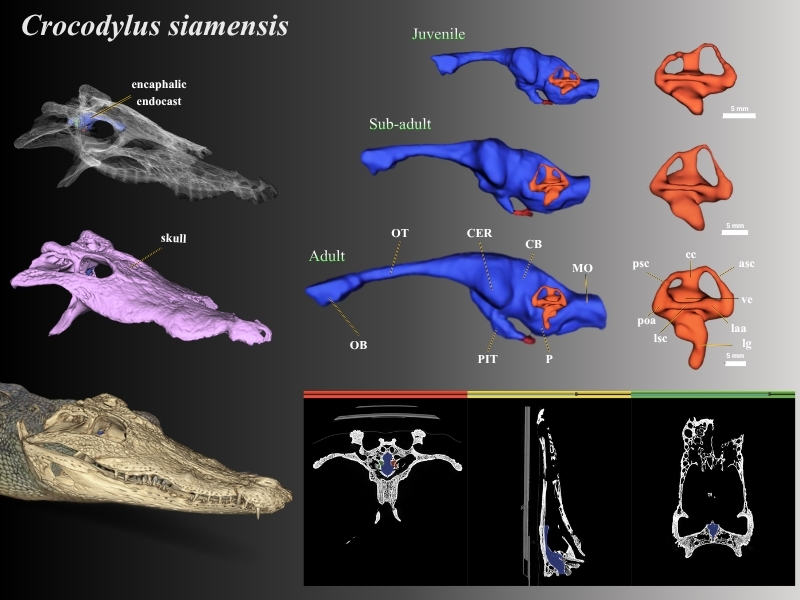
Crocodilian brains are hidden behind massive skulls, yet their internal anatomy preserves a record of how sensory systems change as the animal grows. This study provides a rare ontogenetic view of the encephalic endocast and endosseous labyrinth of the Siamese crocodile (Crocodylus siamensis), using CT-based three-dimensional reconstructions across juvenile, subadult, and adult stages. Rather than treating the crocodilian endocranial cavity as a static anatomical feature, our results reveal coordinated changes in brain proportions, olfactory regions, and the inner ear through growth. These patterns offer a new framework for interpreting sensory development in living crocodylians and, importantly, for reading comparable structures in fossil relatives where only the skull is preserved. By linking growth, function, and evolutionary inference, the study turns the hidden spaces of the crocodile skull into a window on vertebrate sensory evolution.
Read the full article, here