

Opportunistic Alliances: Mealybug-Ant Ecological Networks in Taiwan
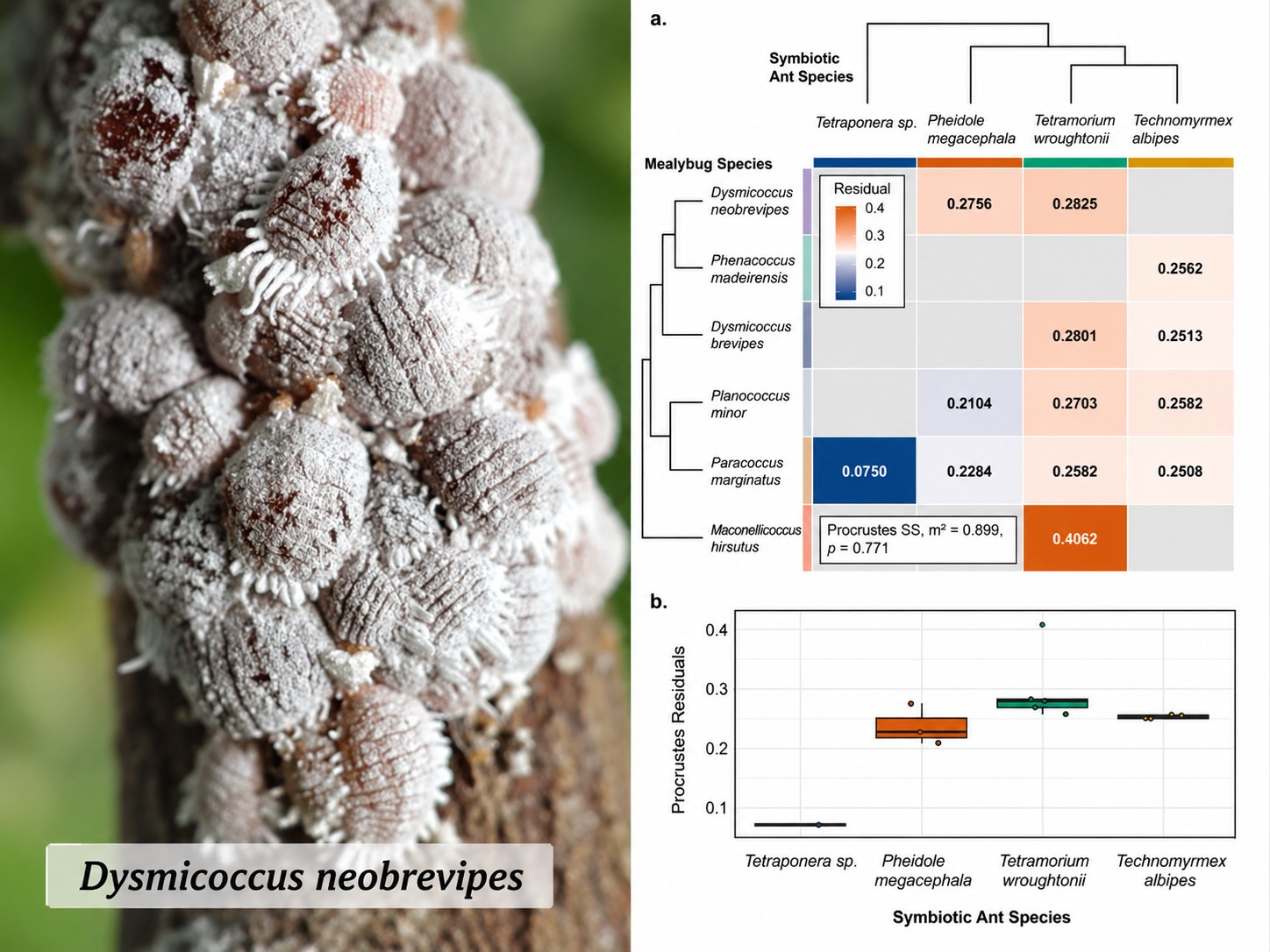
This study investigates how interactions among host plants, mealybugs (Pseudococcidae), and symbiotic ants (Formicidae) shape mealybug diversity. We analyzed 30 tripartite mealybug-ant-host plant combinations from Chiayi and Kaohsiung using COI DNA barcoding, phylogenetic reconstruction, ASAP species delimitation, PACo cophylogenetic analysis, and Shannon diversity metrics. DNA barcoding resolved six mealybug species and four ant taxa, providing a molecular baseline for these interacting communities. PACo revealed no significant global cophylogenetic congruence between ants and mealybugs, indicating limited evidence for tight coevolutionary relationships. Instead, diversity patterns suggested broad host-plant use and generalist ecological networking, consistent with opportunistic partner associations. This study integrates molecular identification and ecological interaction analyses to improve understanding of mealybug-ant associations and provides a reproducible baseline for biodiversity assessment and future agroecosystem network studies.
Read the full article, here