

Environmental Drivers Reveal Key Habitats for Dwarf Hake in Baja California
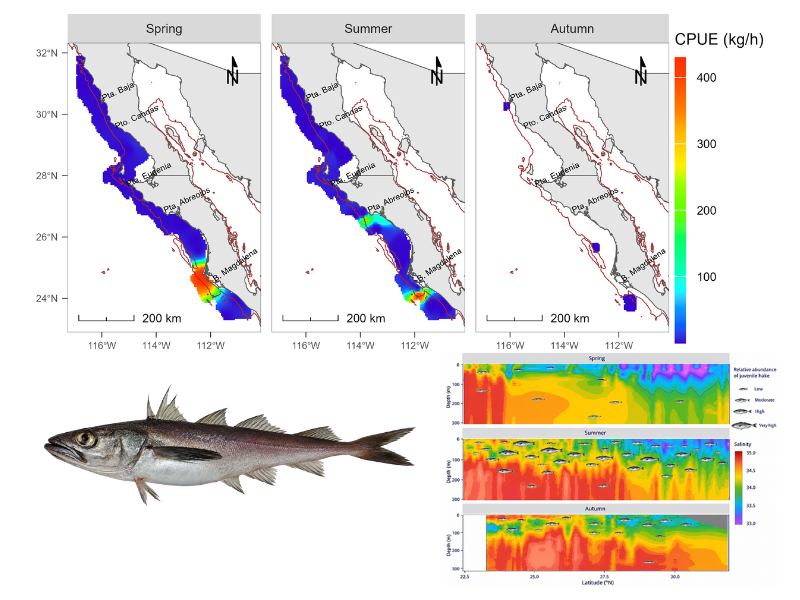
This study provides the first peninsula-wide assessment of the distribution of Dwarf hake (Merluccius productus) along the western coast of Baja California, an understudied resource with potential fishery value. Using data from eight fishery-oceanographic surveys conducted between 2019 and 2024 and delta generalized additive mixed models, we show that hake occurrence and abundance are strongly structured by oceanographic conditions and proximity to the continental shelf edge. Temperature influenced the probability of occurrence, whereas salinity, trawl depth, and shelf-edge distance shaped catch rates. We identify two seasonal centers of abundance, Bahía Magdalena and the Punta Abreojos-Laguna San Ignacio region, and highlight the ecological importance of shelf-break habitats. These findings establish a scientific baseline for targeted biomass assessments, improved monitoring, and the development of stock-specific management strategies needed to evaluate the feasibility of a sustainable Dwarf hake fishery in northwestern Mexico.
Read the full article, here