

Beyond the Heat: Unveiling the Complex Role of solar UV Radiation in Frog Communication
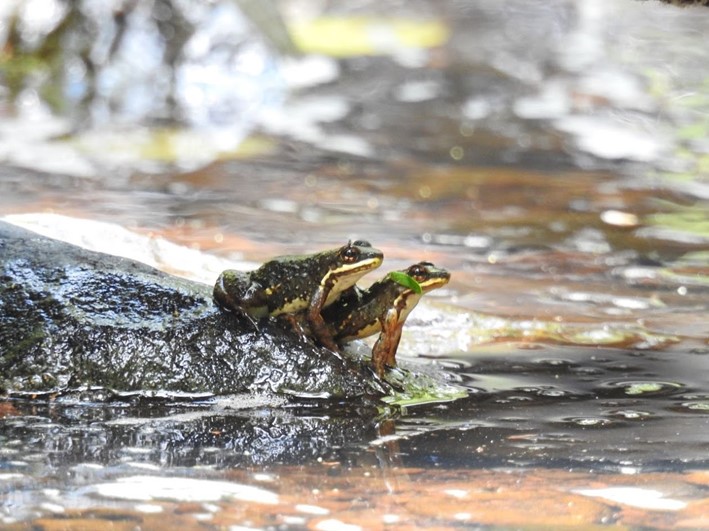
Continuous environmental monitoring has revealed that the thermal and ultraviolet components of sunlight have contrasting effects on the communication of diurnal frogs. Diurnal amphibians are regularly exposed to solar ultraviolet radiation (UV), which can cause DNA damage and force an energetic trade-off with demanding behaviours such as vocalization. To investigate this in natural settings, researchers monitored the calling behaviour of Crossodactylus schmidti, a diurnal forest-specialist frog, using passive acoustic recorders paired with custom data loggers measuring solar UV doses, air temperature, and visible light in a Neotropical stream. The data showed that higher air temperatures and cumulative UVB doses significantly reduced the overall probability of males engaging in calling behaviour. However, the subset of males that continued to call under high cumulative UVB exposure unexpectedly emitted more frequent and longer calls. These findings emphasize the need to consider both the thermal and UV radiation components of sunlight when evaluating how amphibians respond to ongoing environmental and climatic changes.
Read the full article, here