Article
Vol. 65-6, 2026
Effects of Blue Light and Feeding on the Physiological Performance of Reef Corals, Stylophora pistillata and Pocillopora damicornis
Shu-Cheng Zhang, Yen-Chih Lin, Chien-Yi Wu§, Yunli Eric Hsieh§, Yan-Zhen Meng§, Shan-Hua Yang*, Tung-Yung Fan*
Shu-Cheng Zhang
Institute of Fisheries Science, National Taiwan University, Taipei, Taiwan
b0975212390@gmail.com
Yen-Chih Lin
Institute of Fisheries Science, National Taiwan University, Taipei, Taiwan
b0975212390@gmail.com
Chien-Yi Wu
Institute of Fisheries Science, National Taiwan University, Taipei, Taiwan
chienyiwu571@gmail.com
Yunli Eric Hsieh
Systems Biology and Mathematical Modelling Group, Max Planck Institute of Molecular Plant Physiology, Potsdam, Germany
Bioinformatics Department, Institute of Biochemistry and Biology, University of Potsdam, Potsdam, Germany
School of Biosciences, The University of Melbourne, Parkville, VIC, Australia
eric.hsieh1224@gmail.com
Yan-Zhen Meng
Institute of Marine Environment and Ecology, National Taiwan Ocean University
louise10121012@gmail.com
Shan-Hua Yang
Institute of Fisheries Science, National Taiwan University, Taipei, Taiwan
shanhua@ntu.edu.tw
Tung-Yung Fan
National Museum of Marine Biology and Aquarium, Pingtung, 944, Taiwan
tyfan@nmmba.gov.tw
Communicated by Yi-Jyun Luo

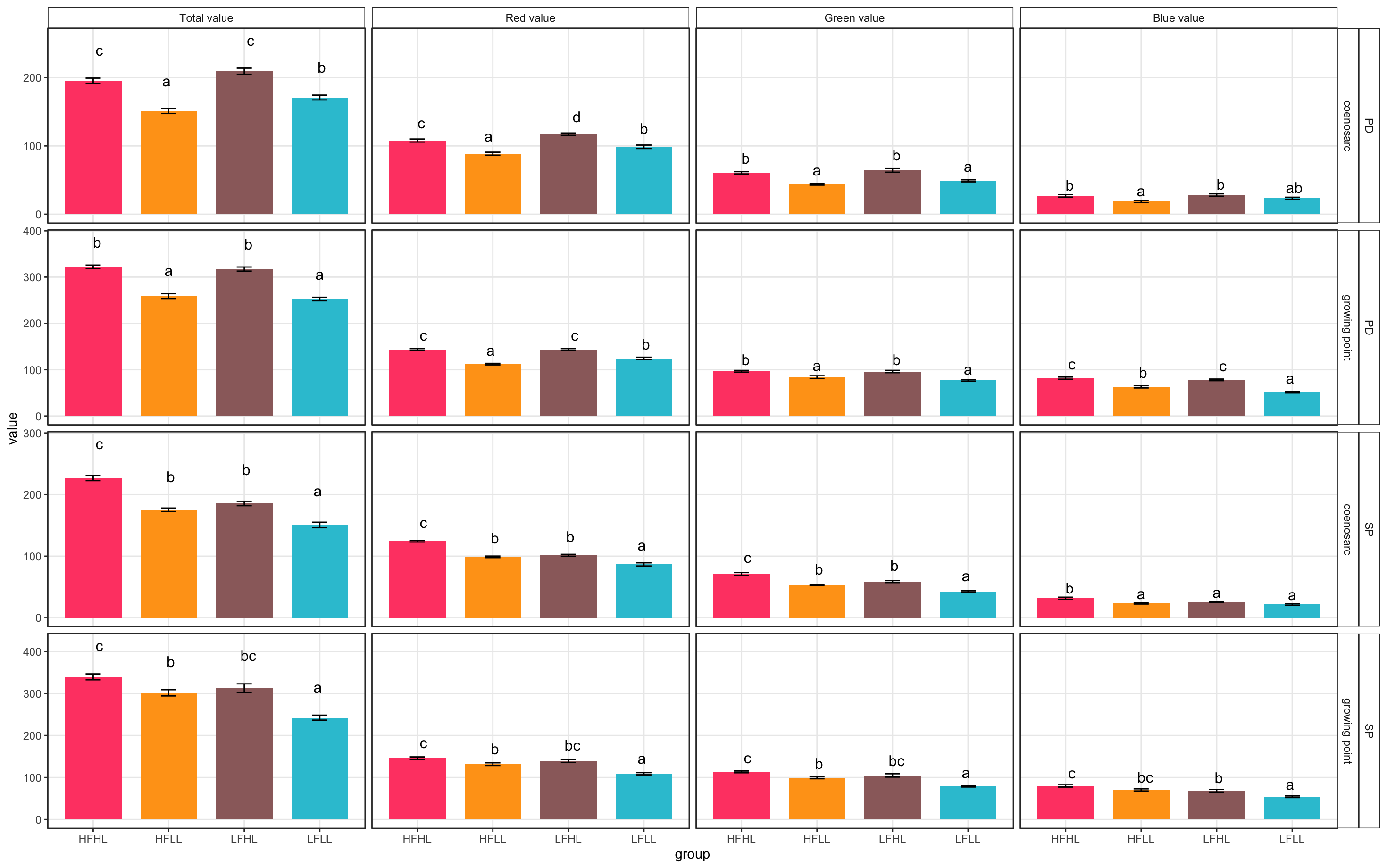
Previous studies have shown that culturing corals under controlled blue light can increase calcification rate and stimulate the production of pigments while reducing the photosynthetic capacity of the corals’ symbiotic algae. Additionally, feeding coral can accelerate growth and enhance their resistance to environmental changes. However, most studies have left their combined effects on coral physiology largely unexplored. Here we investigate the effects of two blue light intensities and two feeding concentrations on coral growth rates and color expression during cultivation. We cultured Stylophora pistillata and Pocillopora damicornis under different blue light intensities and fed varying concentrations of enriched brine shrimp (Artemia) twice a week. Both species maintained high survival (100%) and photosynthetic efficiency (Fv/Fm > 0.6). S. pistillata exhibited the highest growth under high-light and high-feeding conditions, while P. damicornis showed no significant growth differences among treatments. However, both species displayed reduced color scores under high-light conditions, as indicated by elevated red-green-blue values. Together, these findings highlight coral species-specific responses to blue light intensity with feeding interactions and demonstrate that manipulating environmental regimes can optimize coral cultivation. This approach supports high-density ex-situ cultivation, advancing both reef restoration and production of corals for ornamental aquariums.

Keywords

Blue light intensity, Aquaculture, Coral growth, Stylophora pistillata, Pocillopora damicornis

Supplementary materials
Fig. S1.   (download)
Table S1.   (download)
Table S2.   (download)
About this article
Citation:

Zhang SC, Lin YC, Wu CY, Hsieh YE, Meng YZ, Yang SH, Fan TY. 2026. Effects of blue light and feeding on the physiological performance of reef corals, Stylophora pistillata and Pocillopora damicornis. Zool Stud 65:06. doi:10.6620/ZS.2026.65-06.

( Received 21 May 2025 / Accepted 20 January 2025 / Published 28 January 2026 )
DOI: https://doi.org/10.6620/ZS.2026.65-06